
9 min read
How to Build a Skincare Routine on a Tight Budget
This page contains affiliate links. As an Amazon Associate I earn from qualifying purchases.
The short answer
A tight budget routine needs three things: a gentle cleanser, a moisturizer, and a broad-spectrum SPF 30 or higher. Buy those first, in drugstore formulas, and add one active — usually a retinoid or vitamin C — only once the basics have been consistent for a month.
Key takeaways
- A gentle cleanser, a moisturizer and a broad-spectrum SPF 30 sunscreen do most of the work in any routine and fit a tight budget.
- Sunscreen is the single product worth most of a small skincare budget, because it prevents the damage the others treat.
- Actives such as adapalene or niacinamide are added only once the three basics are in daily use.
- Cleanser is the step where spending more changes results least, since it is rinsed off within a minute.
Skincare marketing is built on the idea that results scale with price. They do not. The ingredients with the strongest clinical evidence behind them — sunscreen filters, glycerin, ceramides, niacinamide, adapalene, azelaic acid — are all available in drugstore formulas that cost less than a single mid-range serum. What a bigger budget buys is texture, scent, packaging, and occasionally a better-stabilized active. What it does not buy is a different outcome from the fundamentals. This guide splits a small budget across a full morning and evening routine, explains why each slot exists, and shows what to add next when there is money to spend.
Written by Maria Alejandra, founder and editor · Last updated:
Independently researched and reviewed for accuracy. Read our editorial policy or how we research routines.
The three products that matter first
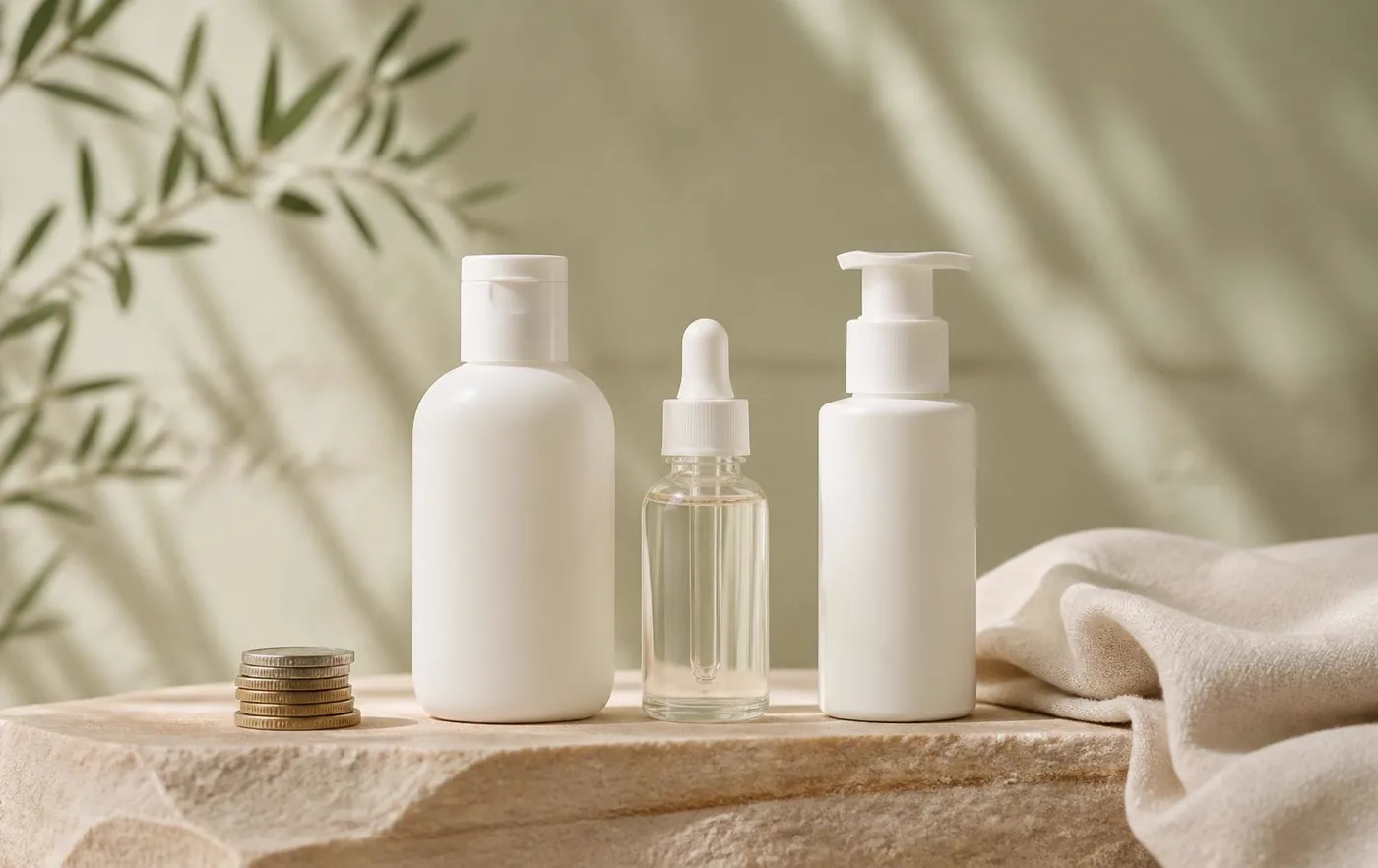
A practical minimum is three steps: clean the skin without stripping it, restore water and lipids, and protect it from ultraviolet damage. Everything beyond that is optimization. If a budget only stretches to three products, these are the three.
Spend the largest share on sunscreen, because it is the step you use most and the one where a formula you dislike becomes a formula you skip.
| Slot | Budget share | What to look for |
|---|---|---|
| Gentle cleanser | Smallest share | Non-foaming or low-foam, fragrance-free, glycerin high in the list |
| Moisturizer | Small share | Ceramides or glycerin plus an occlusive; gel for oily skin, cream for dry |
| Broad-spectrum SPF 30+ | Largest share | A texture you will genuinely reapply; mineral or chemical both work |
| Optional fourth | Nothing for now | Add one active only after four consistent weeks |
Where cheap is genuinely as good
Cleansers are the clearest case. A cleanser is on the skin for under a minute and then rinsed away, so the expensive additives marketed on the bottle have almost no contact time to do anything. What matters is the surfactant system being mild enough not to disrupt the barrier — and gentle drugstore cleansers do that as reliably as luxury ones.
Moisturizers are close behind. Glycerin, petrolatum, dimethicone, and ceramides are inexpensive, well-studied, and present in drugstore creams at the same concentrations used in far pricier jars. The difference you pay for is aesthetic: slip, finish, and fragrance.
Niacinamide, azelaic acid, adapalene, and salicylic acid are all available cheaply, and all have clinical evidence behind them at over-the-counter strengths. There is no budget penalty on efficacy for any of them.

Where spending more can be worth it
Vitamin C is the honest exception. L-ascorbic acid is unstable, and formulating it at a low pH in packaging that keeps out light and air costs money. Very cheap vitamin C serums oxidize quickly — the tell is a serum that turns orange or brown within weeks. If vitamin C matters to you, either budget more for it or use a stabler derivative.
Sunscreen is the other place where price sometimes buys compliance. A more expensive sunscreen is not more protective at the same SPF, but a cosmetically elegant one gets applied at the right thickness every day, and that difference is much larger than any difference between filters.
Everything else — eye creams, essences, toners, masks, ampoules — is optional. None of it is a prerequisite for clear, comfortable skin.

The four-week build order
Buying everything at once is the most common way a budget routine fails: if the skin reacts, there is no way to tell which product caused it. Introduce in stages instead.
- Week 1–2 — cleanser and moisturizer only, morning and night. Let the barrier settle.
- Week 2 — add sunscreen every morning, two finger-lengths for face and neck.
- Once the base routine is comfortable, add one active cautiously and increase only as directed and tolerated.
- Week 8 — reassess. Increase the active's frequency before adding anything new.
What to skip while the budget is tight
Toners as a separate step, sheet masks, cleansing brushes, eye creams, and multi-step layering routines are all discretionary. None of them appear in a minimum effective routine, and each one adds a chance of irritation without adding a documented benefit.
Physical scrubs can add friction and irritation, especially when other exfoliants are already in the routine. If you use a chemical exfoliant instead, choose a gentle formula and follow its label rather than a fixed weekly schedule.
Making a small budget last
Sunscreen is the only product where using less to stretch the bottle undermines the point — under-application is one of the most common reasons SPF underperforms. Buy the size you will actually finish within its shelf life and use the full amount.
For cleanser and moisturizer, larger sizes almost always cost less per use, and both keep well. For actives, buy small: if the skin does not tolerate a retinoid, a large tube is wasted money.
Frequently asked
- Can a tight-budget routine actually work?
- Yes. A gentle cleanser, a moisturizer, and a daily broad-spectrum SPF 30 cover the steps with the strongest evidence behind them, and all three exist in effective drugstore formulas at drugstore prices.
- Which product should I buy first if I can only afford one?
- Sunscreen. It is the step with the largest measured effect on tone, texture, and visible aging, and no other product compensates for skipping it.
- Do I need a toner?
- No. A hydrating toner can feel pleasant on dry skin, but it is not a required step and it is the first thing to cut on a tight budget.
- Is expensive vitamin C worth it?
- Sometimes. L-ascorbic acid needs low pH and airtight, light-blocking packaging to stay stable, and very cheap versions often oxidize within weeks. If a serum turns orange, its useful life is over.
- How long before a budget routine shows results?
- Hydration and comfort may change sooner than tone or texture. Active-related results vary by ingredient, concern, and consistency and often take several weeks or longer.
- Can I use the same routine while pregnant?
- The cleanser, moisturizer, and sunscreen slots are unchanged. Swap any retinoid for azelaic acid, which is inexpensive and pregnancy-safe.